
End Your Osaka Trip with a Street Kart Tour: Easing Your Companions' "Wait, We're Actually Driving?" Worries One Step at a Time, Starting Before You Leave
End Your Osaka Trip with a Street Kart Tour: Easing Your Companions' "Wait, We're Actually Driving?" Worries One Step at a Time, Starting Before You Leave
It's the morning of your last day. The suitcases are half-zipped. Someone quietly asks, "So what should we do before we go?"
One more round of shopping? That's fine. But wait a moment. What if, for your final stop, everyone got behind a wheel?
In Minami, Osaka, there's a Street Kart tour where a guide leads you through the city in karts. Make it the finale of your trip, and your companions will probably change their tune three times. When you book: "Wait, seriously?" Just before driving: "Are we going to be okay?" After getting out: "I want to go again."
Those three stages are worth seeing for yourself.
This article walks through the "I have no idea what's going to happen" worries that first-time visitors to Japan tend to have, and eases them one by one, following your companions' reactions in order. Let's start at the beginning.
Why You Should Save a "Doing the Same Thing Together" Moment for the End of Your Trip
On trips in Taiwan, the last day often goes like this: buy souvenirs, then head to the airport. Sound familiar?
It's the same in Japan. On the final day, everyone scatters to different shops and drifts back one by one at the meeting time. That's fun in its own way. It really is. But when you try to sum up the trip in a single photo, you notice something: there aren't many photos with everyone in the same scene.
Put a street kart tour at the end, and for that stretch of time everyone shares the same experience. The karts are single-seaters, so everyone drives their own. Nobody just sits in the passenger seat and watches.
That's why the conversation afterward is just as excited for everyone. "That intersection had my heart racing!" "The person in front of me looked like they were having so much fun." Each of you saw something different, but the conversation keeps coming back to the same places. That's the best part.
Ride at the start of a trip, and it works as a preview of the sightseeing ahead. Ride at the end, and you get to see the streets you've already walked from a different height. The Dotonbori signs you walked past the day before. The front of that vintage shop you went into in Amerikamura. Drive past them in a kart, and your companions will want to point. "Hey, that's where we were yesterday!"
That's the whole point of saving it for last.
By the way, in Chinese, a go-kart is "卡丁車 (kǎdīngchē)." To invite your friends, just say "最後一天去開卡丁車吧!" ("Let's go karting on our last day!"). That'll get the message across. Go ahead and send it.
What Your Companions Will Worry About Most When You Book
Right after "That sounds fun!" comes the inevitable: "But can we actually drive?"
It's coming, guaranteed. So let's deal with it first. Once that's settled, the rest of the plan falls into place.
Check Your Driver's Licenses Before You Plan Anything Else
Street karts drive on public city roads, so you need a driver's license.
Which countries' licenses work, and what documents you need, varies by country. Don't guess. Look at the official guide (Driver's License Information) together with everyone in your group. Yes, everyone.
Timing matters: check before you arrive in Japan. Some countries require documents you can only get by preparing in your home country before you leave. What happens if just one person doesn't meet the requirements? The time that was supposed to be your grand finale becomes waiting time for them. That would be far too sad.
The fix is simple. Post that link in your group chat and say, "Everyone check this, please." That's it. That alone prevents the day-of "Wait, I'm the only one who can't ride?"
One more thing to check before you book: how everyone is feeling physically. The karts have no suspension, so every bump in the road goes straight through your body. They are not recommended for pregnant women, who are advised to consult a doctor. The karts are single-seaters, so you can't ride along with someone else either. If someone in your group won't be driving, decide at the booking stage where they'll spend their time during the tour.
Tour Language and How to Book
Let's be upfront here. On the day of the tour, guidance is basically in English. Whether you can get instructions in Japanese or other languages depends on the staff that day, and it isn't guaranteed.
If someone in your group isn't comfortable with English, you have two options: have someone who's good at English sit next to them and interpret, or ask about it when you book. Decide which one ahead of time, and everyone will feel a lot more relaxed.
On the other hand, the Street Kart official website is available in 22 languages, including Traditional Chinese, so feel free to do your research on the site before booking. Reservations are accepted via Facebook, LINE, or email, and the contact details are listed on the Street Kart official website. LINE is a familiar app in Taiwan too, so having whoever uses it most get in touch on behalf of the group is the fastest way.
One more thing. Weekends tend to fill up, so once your itinerary is set, book early. Cancellations are free up to 7 days before, so it's easy to take the first step even if your dates aren't completely fixed. Prices vary by season and time of day, so check the official website (kart.st) for the latest rates.
How to Answer "How Long Does It Take?"
This is probably what your companions most want to know: how long it takes.
That depends on the plan and on conditions that day, so this article won't give a definite answer. Please confirm the details with the official booking contact when you reserve.
Just one piece of advice: if you're making it your trip finale, don't schedule it right up against your return bullet train or flight. On the day, there's check-in and a safety briefing before departure. Check the official website when you book to find out how early you need to arrive.
There's another last-day pitfall: luggage. The shop has lockers for small items, but they're not suited to large bags like suitcases. If you're heading over after checking out, figure out ahead of time how you'll travel light, such as leaving your suitcase at the hotel. Planning is easier if you assume all you can bring on the kart is a small bag.
Rather than "it's the last day, so let's cram everything in," go with "it's the last day, so let's leave some breathing room." That way, your companions stay relaxed right to the end. Honestly.
On the Day: Getting to the Shop in Minamihorie
The Osaka shop is in Minamihorie, a neighborhood full of stylish shops and cafés, with a vibe similar to Ura-Harajuku in Tokyo. The kanji are "南堀江," literally "south moat inlet," and the meaning is exactly what it says. If you read Chinese characters, you can probably picture the area just from the name.
The shop has no parking, so take the train. The nearest station is Nishi-Ohashi on the Osaka Metro Nagahori Tsurumi-ryokuchi Line, a 3-minute walk away. From Yotsubashi Station on the Yotsubashi Line, it's a 5-minute walk. Check the official website (kart.st) for directions from each station.
Here's a little tip. Osaka stations have a lot of exits. Even at the same station, a different exit can put you somewhere completely different above ground. When you pull up the walking route to the shop on Google Maps, check which exit to use too. Then you won't get lost.
Take another look at your outfit before you leave, too. On the last day, with souvenir photos in mind, you might be tempted to wear a dress or sandals. But if you're driving a kart, closed-toe shoes are recommended, sneakers if possible. Heels, open-toe shoes, skirts, and dresses are listed as things to avoid. Comfortable casual clothes like jeans are fine. In summer, a hat, sunglasses, and sunscreen will come in handy.
Some days the sky looks a bit uncertain. In light to moderate rain, the tour goes ahead as planned, and raincoats are provided free of charge. In heavy rain or a typhoon, the tour is canceled, and you can choose between a shortened tour (with the difference refunded), rescheduling to another day, or a full refund. On the last day of a trip, switching to another day usually isn't realistic. If the forecast looks iffy, talk with your companions the night before about which option you'd pick, so you won't panic on the day.
Now, the trip over there is when your companions' nerves peak.
Someone might ask, "They drive on the left here, right?" Yes. In Japan, cars drive on the left. Taiwan drives on the right, so it really is the opposite. It's natural to feel uneasy.
But don't worry. On the tour, the guide drives in front and everyone follows behind. You don't choose the route yourself. You follow the guide along a set route for each shop. No need to worry about where you're going.
When you arrive at the shop, there's a safety briefing before you set off: how to operate the kart, the route, and things to watch out for. Any "driving on the left" worries from the trip over can be cleared up again here. The briefing is basically in English, so have someone good at English sit next to anyone who isn't. Everyone wears a helmet, provided free of charge along with goggles.
Share how all this works with your group on the way there. You'll watch those "Are we going to be okay?" faces gradually relax.
Your Companions' Faces Once You Hit the Road
You're off. Right away, your companions' expressions change.
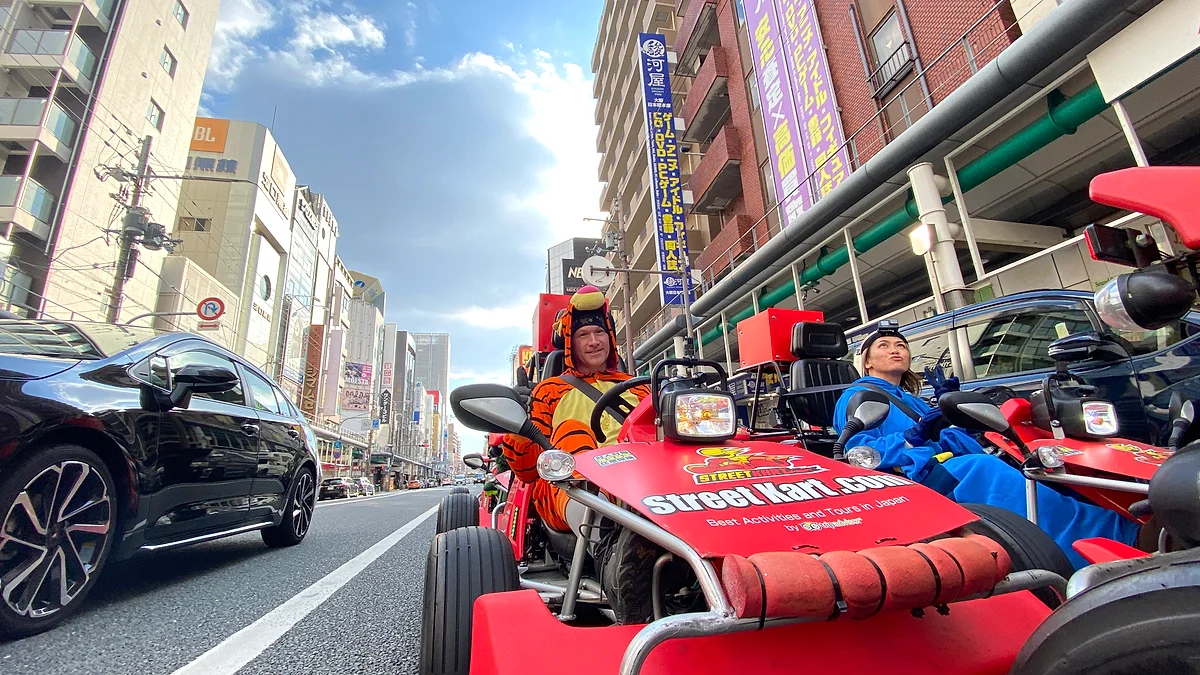
In a kart, you sit really low. The tires of buses and trucks, which you'd never normally look up at, are right beside you. The wind hits your face. The sounds of the city pour straight into your ears. Even the little bumps in the road you never noticed while walking come through to the palms of your hands on the wheel.
If you let out a "whoa!" here, there's nothing to be embarrassed about. Go ahead and let it out.
The Osaka shop's route takes in the heart of Minami: from Minamihorie through Yotsubashi and Horie, Amerikamura, Shinsaibashi, Namba, and Dotonbori.
Amerikamura is a neighborhood lined with vintage clothing shops and streetwear stores, and there's always a crowd around Triangle Park. Anyone who went shopping here the day before will definitely want to shout, "That shop!"
Shinsaibashi is one of Osaka's signature shopping districts. The arcade entrances slide past one after another, and you get to watch them from down low.
And then Dotonbori. As you get closer, the atmosphere gets livelier. Huge signs. Neon lights. Lines of people at the takoyaki stands. It's pronounced "Dōtonbori." The kanji alone can be tricky to read, so teach your companions. "Oh, that's how you say it?!" makes for a fun little conversation starter. This is a street where you'd be swept along by the crowds on foot, and you get to look up at it from kart height. There's no other word for it: it's genuinely moving.
But here's one important caution. While driving, don't hold your phone. Focus on driving. That's the basic rule of a tour where you follow a guide.
I get wanting to take pictures. I really, really do. But photos in front of the shop before departure and after you arrive are plenty. If anything, the scenery you couldn't capture is exactly what gets the conversation going once you're done.
Honestly, your companions' reactions are funniest at red lights. The moment you stop, you lock eyes with your friends in the karts in front and behind, and you can't help but laugh. People on the sidewalk might even look over and wave.
Of all your days on the trip, the moment you feel most like you've become part of this city is right there, I think.
After You Get Out: How to Spend the Last Hours of Your Trip
Right after getting out of the kart, your companions will probably be a little buzzed and a little hungry.
How you spend the time from here shapes the afterglow of your finale. Here are a few ideas.
If you want to sit down and talk at a relaxed pace, head to Hozenji Yokocho. About a 20-minute walk from the shop, it's a narrow alley lined with kappo and Japanese restaurants. From wind and engine noise just moments ago to steaming food in a quiet alley. That contrast is what makes the last memories of your trip so vivid.
If you've still got energy to walk, go back to Dotonbori. Retrace the places you just drove past, this time on foot. If you're taking a group photo in front of the Glico sign, step back a bit. The trick is to find the angle that fits the sign, the river, and everyone's faces into one frame. For hashtags, try "#大阪旅行" (Osaka trip) and "#道頓堀" (Dotonbori), plus the Chinese "#大阪自由行" (Osaka independent travel).
If anyone wants to pick up some last-minute souvenirs, go to Daimaru Shinsaibashi. Japanese department stores have food halls in their basements, known in Japanese as "depachika." Japanese souvenirs are often beautifully packaged, so count how many people you're giving them to and choose individually wrapped items to make them easy to hand out.
If you have time to spare and love seafood, Kuromon Market, about 10 minutes away by train, is another option.
But if your train or flight home is coming up soon, don't push it. Remember: the whole reason you put the kart tour at the end was so your last day wouldn't feel rushed.
Get Everyone's Faces in the Last Photo of the Trip
On the last day of a trip, the "it's almost over" feeling always seems to come first. I get it. I feel the same way.
That's exactly why you should set aside time at the end for everyone to share the feel of the same steering wheel.
"Seriously?" at booking. "Are we going to be okay?" before setting off. "Again!" after the ride. Only the people you traveled with get to see all three of those expressions. It's a front-row seat that's yours alone.
There are just three things to do. First, have everyone in your group check the driver's license information page. Next, check the official website for booking contacts and the latest information. And if you're going on a weekend, get in touch early.
That's all. After that, all that's left is to drive.
Head over to the Street Kart official website and lock in the final hours of your Osaka trip!
This article was originally written in Japanese and translated using AI. Some expressions may read unnaturally, and we appreciate your understanding. For the most accurate and up-to-date information, please refer to the official site at kart.st.
Street Kart is not affiliated with Nintendo or the Mario Kart series in any way. We do not provide costumes of Nintendo characters, and such costumes may not be worn during tours even if brought by participants.